

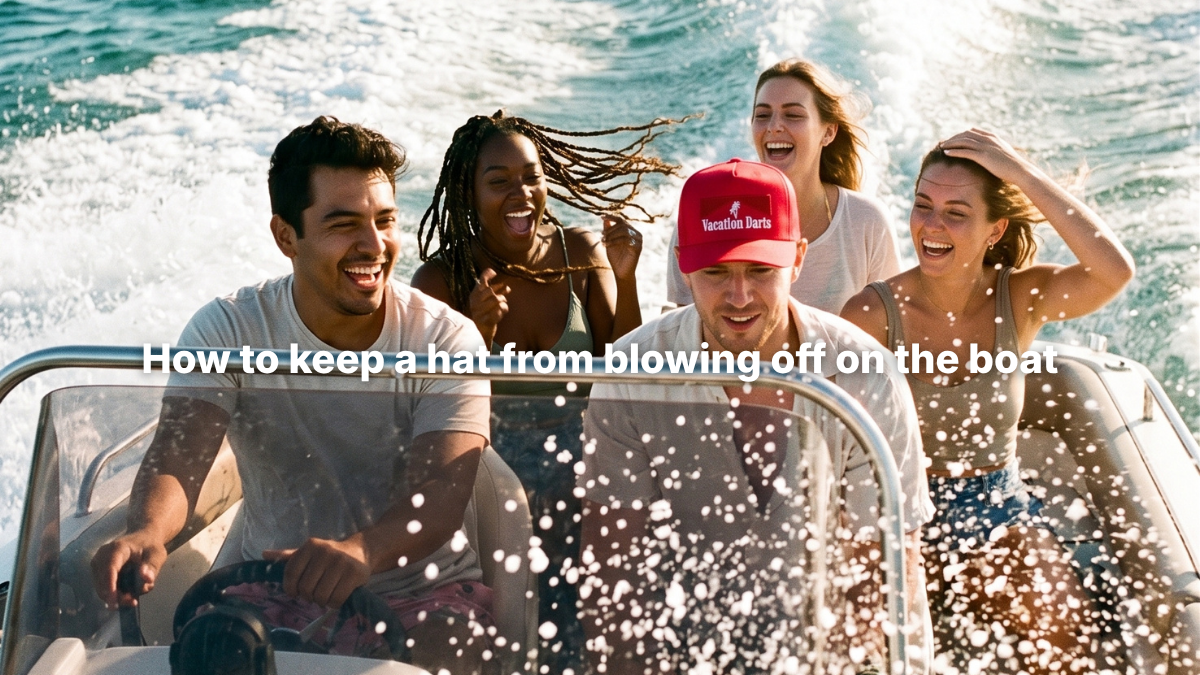
The single most reliable way to keep a hat on in wind is to start with the right fit and the right hat style for the conditions. A well-adjusted snapback or a structured trucker with a mesh back sits closer to your head than a loose dad hat and gives the wind less to grab. A few extra tricks help when things get serious out there.
Why does a hat blow off on a boat in the first place?
Wind on the water is different from wind on land. You get consistent, strong gusts with almost nothing to break them up, and the boat itself is moving and adding speed to whatever is already blowing. A hat that feels perfectly fine walking to the marina can become a projectile the moment you leave the dock. The brim acts like a sail, catching air and lifting the front of the hat away from your head. The higher the profile and the flatter the brim, the more lift you get.
Which hat style actually stays on in wind?
Trucker hats and snapbacks tend to hold better on the water than a soft unstructured dad hat. The structured front panel keeps its shape so the hat sits consistently on your head rather than shifting around. The adjustable snap or clasp at the back lets you dial in the fit tightly enough to matter without squeezing your skull.
The Tobago Trucker Hat is a good call here. The mesh back breathes well in the heat while the structured front stays put, and the name alone is appropriate for anything involving water. If you want something with a slightly lower profile and a cleaner look, the Nazare Snapback is named after a Portuguese coastal town famous for having some of the biggest waves on earth, which feels thematically correct for keeping your hat on in serious conditions.
How tight should a hat be on a boat?
Tighter than you think. Most people wear their hat at a comfortable park-and-sit level of tightness. On a boat, you want it snug enough that you can shake your head firmly and feel no movement. That is the baseline. If there is any wobble or lift when you tilt your head forward, the wind will find it.
With a snapback, close it one or two notches tighter than usual. With a trucker, same logic. Some people add a hat clip or a cord that runs under the chin, which is genuinely useful if you are going fast or fishing offshore where the gusts are serious. It looks a little dorky and that is fine because at least you still have your hat.
Does brim angle make a difference?
Yes, and it is one of the most overlooked factors. A curved brim is more aerodynamic than a flat one. The curve helps redirect airflow up and over the hat rather than catching underneath it. If you are already committed to a flat brim, you can try curving it slightly by hand or bending it around a water bottle overnight. Not everyone wants to do that to their hat, which is fair, but it does work.
Wearing the brim slightly lower toward your eyes also reduces the angle at which wind gets underneath it. It also keeps the sun off your face better, so it is a genuine two-for-one.
What else can you do to keep a hat on in wind?
A few practical moves that actually help:
- Use a hat clip or hat saver cord. They attach to the hat and clip to your collar or shirt. Simple and effective.
- Wear sunglasses with the arms over the hat band. This adds a small amount of resistance and keeps the hat pressed down slightly, especially helpful with a snapback where the band sits lower on the head.
- Wet the sweatband slightly before you put it on. A damp band creates a small amount of grip against your forehead that makes a difference in moderate wind.
- Store your hat below deck when you are actually underway at speed. If you are anchored or moving slowly, you are fine. If you are running at 25 knots, no hat in the world is going to cooperate without a chin strap.
- Turn it around. Wearing a snapback backwards eliminates the brim entirely and removes almost all the wind resistance. You lose sun protection on your face but you keep your hat. Situational awareness is key here.
What about golf hats on the course in the wind?
Same principles apply. A golf course with no tree cover can get genuinely windy, especially on coastal or links-style layouts. A structured snapback or a well-fitted hat with some weight to it holds better than a lightweight cap that sits loosely. The St. John's Golf Hat is built for this kind of use, styled for the course but practical enough to survive a breezy back nine without you spending the round chasing it across the fairway.
The honest summary
Fit is everything. A hat that fits properly and sits low enough on your head can handle a solid amount of wind without drama. Choose a structured style, tighten the adjustment, curve the brim if you can, and use a hat clip when the conditions get serious. Vacation Darts started as a single inside joke in Santorini and grew to 42,000 Instagram followers, so the brand has some experience with warm-weather, on-the-water situations. The hats are built to go places with you, which includes places where the wind has opinions.
Get out there. Hold onto your hat. Or don't and just buy another one. The Tijuana Trucker Hat would not be the worst consolation prize.


